Showing Posts From
Ai investment cost
- 16 Jun, 2026
Delayed AI Adoption: The Financial Cost CFOs Aren't Modelling
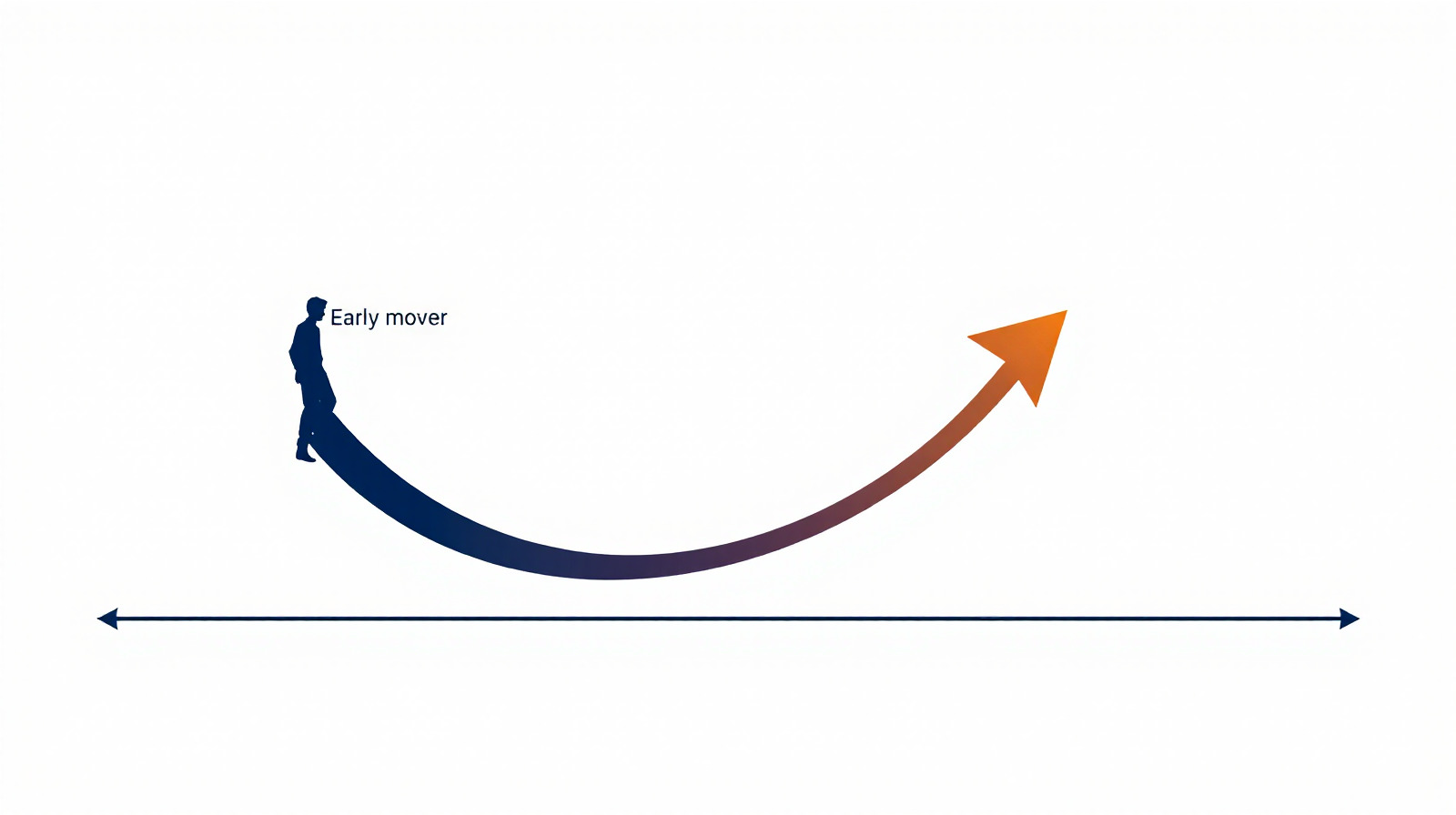
I've sat in enough quarterly reviews to recognise the posture. The AI agenda item comes up. The CFO gives the answer: "We're watching the space. We'll move when the ROI is clearer." The room nods. The item closes. And on the spreadsheet, there's a zero next to AI investment, which looks indistinguishable from prudence. The problem is that "watching" has a price that doesn't show up in that spreadsheet. It doesn't appear as a line item, a variance, or a write-down. It accumulates in places that only become visible later — in an attrition number that looks like a hiring problem, in a sales cycle that looks like a pricing problem, in a capability gap that looks like an execution problem. By the time it surfaces, the framing has already shifted from "we were careful" to "we fell behind." This isn't an argument for reckless AI spending. Most organisations that rushed in during 2023 and 2024 wasted money and generated reports nobody read. But the CFO who treats inaction as cost-free is making a financial modelling error. What follows is what that error actually looks like — and what a realistic cost-of-delay framework should account for. Why inaction looks free on the balance sheet CFO decision-making is built around visible costs. You can see what an AI pilot costs. You can see infrastructure spend, vendor contracts, and the headcount required for an AI team. What you cannot see — at least not immediately — is what a competitor's AI programme is costing you. This creates a structural asymmetry. Every pound spent on AI shows up as a cost. Every pound not spent shows up as nothing. The CFO's instinct, correctly shaped by years of capital allocation discipline, is to treat the nothing as neutral. It isn't. The parallel I find useful: data infrastructure in the early 2010s. Companies that invested in data warehousing and analytics capabilities between 2010 and 2015 weren't seeing obvious short-term returns. The value was in what they could do in 2017 and 2018 that competitors couldn't — run faster experiments, personalise at scale, catch fraud earlier. Organisations that waited for "clearer ROI" were, by the time they understood it, three years behind on the foundational work. AI has a shorter compounding cycle than data infrastructure did. An organisation that started building internal AI capability in 2023 has two years of institutional learning — how the tools fail in their specific context, which processes respond to automation and which don't, how their workforce adapts — that cannot be purchased. You can buy the tools. You cannot buy that understanding. Where the cost of delay actually lands "Competitive disadvantage" is too abstract to put in a financial model. Here is where delayed adoption creates measurable exposure. Talent is the most immediate and least visible cost. Engineers, analysts, and operations leads who want to work with AI tools are choosing employers who give them access to those tools. This is happening now. I've spoken to CTOs at organisations in the "we're monitoring" camp who are losing mid-level technical talent at a rate they're attributing to compensation. Some of it is compensation. A significant portion is that their competitors' engineers are doing more interesting work with better tools. The cost per lost hire — recruiting, onboarding, lost productivity during the gap — runs into six figures per person. That is quantifiable. It belongs in the model. Sales cycles are also affected in industries where AI is showing up in how deals are won. In financial services, insurance, logistics, and professional services, the competitor who can demonstrate AI-driven capability in a client meeting has a different conversation than the one who cannot. I've seen deals where the question is no longer "can you solve the problem" but "can you solve it at AI speed." The organisation that answers "not yet" is competing on a different basis. Process cost differential compounds every month. AI is reducing the unit cost of specific tasks — document processing, contract review, first-pass analysis, compliance checking — at rates between 40% and 80% depending on the task and the organisation. Every month a competitor runs those processes at that cost and you don't, the gap widens. For high-volume document-heavy operations, the monthly difference is not marginal. Data maturity debt is the cost that CFOs most consistently underestimate. AI systems improve with more data and better-structured data. An organisation that started an AI programme two years ago has two years of logged interactions, feedback loops, and model fine-tuning data. An organisation starting today has none of it. You cannot buy your way to that data — you can only accumulate it over time. The capability gap is not just in tools; it's in the training material that makes those tools work better for your specific context. Why the gap grows faster than expected The CFO who plans to "move when the ROI is clearer" is making an implicit assumption: that the cost of delay is roughly linear. Start now or start in twelve months, and you're twelve months behind. That's not how this works. AI advantages compound because data, models, and institutional knowledge reinforce each other. An organisation with a functioning AI programme is generating data from that programme. That data improves the models. Better models drive more adoption. More adoption generates more data. The gap between an early mover and a laggard doesn't grow at a steady rate — it accelerates. The organisation that is twelve months ahead today may be twenty-four effective months ahead in two years. Because the twelve months they had in advance were spent building capability that you have not yet started building. When you start, they are already iterating on systems you haven't built yet. In financial services, early adopters of AI-driven fraud detection are now running third and fourth-generation models trained on proprietary incident data. A bank entering the space now is not competing with those organisations' first-generation system — it's competing with what three years of production data and model iteration produces. That gap does not close in twelve months of effort. The point where an organisation can no longer close the gap through effort alone — where the advantage of the early mover becomes structural — varies by industry and use case. Across the sectors I work in, that inflection point is closer than most boards think. In some categories, it has already passed. What a cost-of-delay model actually looks like This is not a case for spending on AI without a plan. It's a case for modelling inaction honestly. A cost-of-delay model has three components that can be estimated with reasonable precision. The first is talent cost. Estimate the annual attrition rate in AI-adjacent roles and identify what fraction is tool-related rather than compensation-related — even 10% to 15% of technical attrition is significant. Multiply fully-loaded replacement cost per hire by that number. Add the cost of the skills gaps that accumulate while roles sit open. This gives a floor figure for what "watching and waiting" costs in people terms each year. The second is process cost differential. Map the three to five highest-volume internal processes where AI is demonstrably reducing costs elsewhere in your industry. Estimate current unit cost and monthly volume. Apply a conservative automation impact — 40% cost reduction is within what production deployments are showing for document-heavy processes. The monthly gap between your cost and a competitor's is the delay cost for that process cluster alone. The third, and often the largest, is capability catch-up cost. When the organisation eventually commits, it will need to hire specialists, build or acquire infrastructure, structure years of accumulated data, and run the pilots that should have been run earlier. Estimate this as 18 to 24 months of foundational work — the industry average from a standing start to meaningful production capability — multiplied by the fully-loaded cost of the required team. Add an opportunity cost factor for the efficiency or revenue the programme would have generated during that period. When I've helped CFOs run this model against a realistic "commit now" versus "commit in twelve months" scenario, the gap between the two paths is consistently larger than expected. The upfront investment in committing now is visible. The accumulated cost of waiting is spread invisibly across multiple budget lines over multiple years. What to take from thisModel inaction explicitly. The "watch and wait" position carries a real cost — it just doesn't appear in a standard budget. Build a cost-of-delay estimate and put it next to the investment case so the comparison is visible. Separate AI spending from AI capability building. Buying tools without building institutional knowledge is waste. Refusing to build capability because tools look expensive misses the point. The value accumulates in understanding and proprietary data over time, not in licence fees. Quantify talent exposure now. Pull your technical attrition data and have an honest conversation with your CTO about how much of it is tool-related. This is the fastest element of the cost to make concrete. Identify the two or three highest-volume internal processes where AI is reducing costs for competitors in your sector. These are your first comparison points for the process cost differential. Ask your CIO what starting in the next 90 days actually requires — not to scale, but to begin accumulating the data and institutional knowledge that makes later scaling possible. The 90-day question has a different, usually lower, barrier than the full programme question. Bring the compounding argument to your board. The question is not "when should we invest in AI" — it's "at what point does the gap become structural, and are we near that point in our sector." That is a strategic risk question that belongs in front of the board with the same treatment as any other structural competitive risk.The organisations that fell furthest behind on digital capabilities in the 2010s were not, in most cases, the ones that actively rejected the technology. They were the ones that treated the decision as something that could wait for better evidence. Better evidence kept arriving. So did the gap. I'm not suggesting evidence doesn't matter or that every organisation should move at the same speed. But the CFO's job is to model risk honestly, including the risk of standing still. In most sectors right now, that risk is underpriced.
Read full article