Enterprise ML Model Selection: How to Choose Without Getting It Wrong
- 12 Mins read

Every enterprise ML project I’ve seen go wrong had one thing in common: the team picked the model before they understood the problem. Not the business problem — they usually had that written down somewhere. I mean the operational problem: what does production actually look like, who consumes the output, what happens when the model is wrong, and what does the organisation’s tolerance for that look like.
Model selection in enterprise settings is treated, too often, as a technical decision. The data scientists run a few benchmarks, the most accurate model wins, and the project moves forward. Six months later the model is sitting in a notebook because no one can explain its outputs to the risk committee, or it’s running too slowly at inference to be useful, or it requires a retraining cadence no one budgeted for.
This is the article I wish existed when I was doing this work early in my career. It’s not about which model architecture is theoretically best for a given data type. It’s about how to think through the selection decision in a way that holds up when the project hits the real world — regulatory scrutiny, budget conversations, operational constraints, and the thousand other things that don’t appear in benchmark papers.
The framework here is built from real projects, primarily in financial services, insurance, and logistics. The patterns apply more broadly. Where I’ve seen exceptions, I’ll say so.
The question you’re not asking at the start
Most teams start model selection by asking: what model performs best on our data?
That’s the third question you should ask. The first two are:
- What does the model’s output need to do in the system it’s deployed into?
- What are the non-negotiable constraints on how the model operates?
Output requirements determine what “performance” even means. A credit risk model that predicts default probability doesn’t just need to be accurate — it needs to produce a calibrated probability, because downstream systems are making threshold decisions based on it. An object detection model for warehouse automation doesn’t need the highest mAP score; it needs consistent latency under 50ms with a failure mode that’s recoverable. A demand forecasting model for supply chain might need interpretable feature contributions so planners can override it credibly.
Once you know what the output actually needs to do, you can define a meaningful evaluation metric. Before that, you’re benchmarking against a proxy that may have nothing to do with operational success.
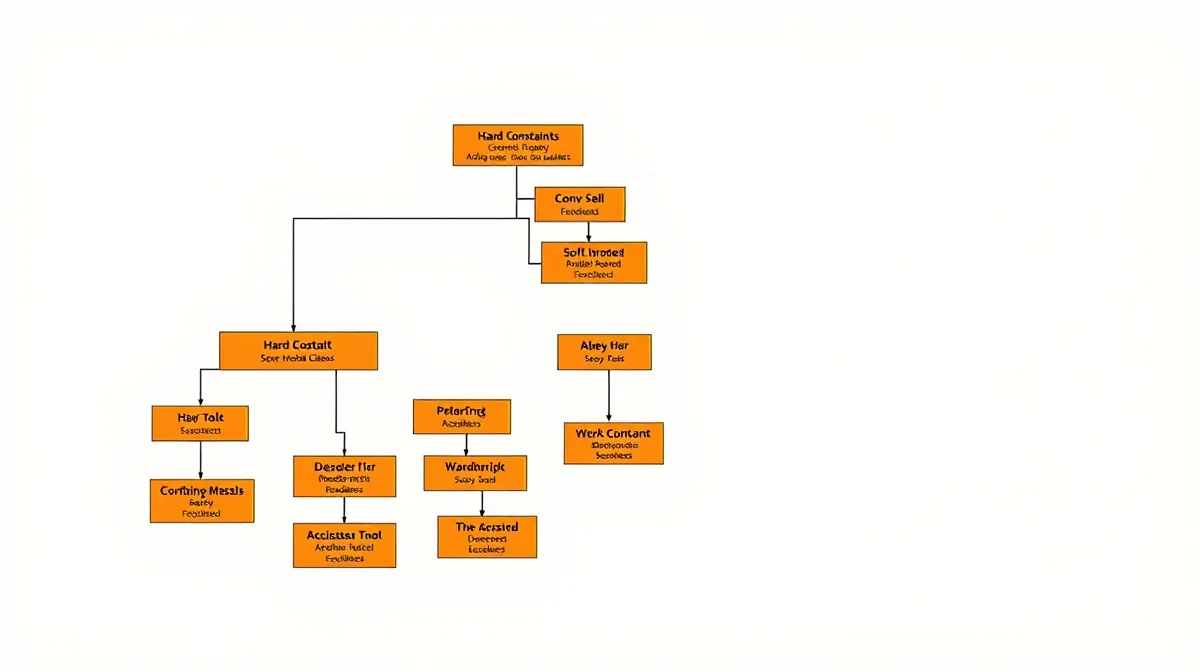
Non-negotiable constraints come in two flavors: hard and soft. Hard constraints eliminate entire model classes before you’ve run a single experiment. Soft constraints shape the selection decision once the hard constraints narrow the field.
Common hard constraints in enterprise:
- Inference latency — if you need sub-100ms response in a user-facing API, large transformer models are off the table unless you have a serious serving infrastructure budget
- Explainability requirements — if a regulator requires feature-level explanations for every decision (common in credit, insurance underwriting, and healthcare), black-box models require an explanation layer that adds its own failure modes
- Data residency — if training data cannot leave a specific jurisdiction, any model requiring cloud-based training infrastructure is constrained
- Retraining frequency — if your data distribution shifts fast and you cannot support frequent retraining, you need a model that degrades gracefully or one that incorporates online learning
The soft constraints — deployment complexity, team familiarity, tooling compatibility — shape the shortlist once the hard constraints have done their filtering work.
Why model complexity is a separate axis from model performance
There’s a prevailing assumption in ML that a more complex model is always better if you have enough data. In research settings, this is often true. In enterprise settings, it creates a class of problems that don’t show up until the model is in production.
Complexity has costs that compound over time:
Debugging cost. When a complex model produces an unexpected output — a prediction that triggers an alert, a recommendation that contradicts business logic — the investigation takes longer. With a gradient boosting model, a skilled analyst can often trace the output back to specific feature values within minutes. With a deep neural network, you may be running attribution methods that give you approximate explanations, not definitive ones.
Retraining cost. A neural network that takes six hours to train on a GPU cluster has a different operational footprint than a gradient boosting model that trains in twenty minutes on CPU. If your use case requires weekly retraining — common in fraud detection, recommendation, and demand forecasting — that cost is real and recurring.
Serving cost. Large models have larger memory footprints and higher per-inference compute requirements. At low request volumes this is invisible. At scale it becomes a line item that someone will eventually want to reduce.
Team dependency. A model that only one or two people on the team can work with is a risk. It’s not a model risk — it’s a key-person risk disguised as a technical choice.
None of this means you should always pick the simpler model. It means complexity should be justified by the performance gain in terms that the business actually cares about. “Our test AUC went from 0.87 to 0.91” is not a justification. “This 4-point AUC improvement translates to £2.3M in annual fraud loss reduction, and here’s the operational cost of running the more complex model” is.
The four model classes you’ll actually choose between
In practice, most enterprise ML problems resolve to one of four model families. There are edge cases and exceptions, but if you’ve been in the field long enough, you know that 80% of production ML at enterprise scale runs on:
- Gradient boosting (XGBoost, LightGBM, CatBoost)
- Linear and regularised linear models (logistic regression, ridge, lasso, elastic net)
- Ensembles on structured data (stacking, voting classifiers)
- Neural networks (feedforward networks, CNNs, RNNs — for image, audio, and dense sequential data)
The fifth category — time series models (ARIMA, Prophet, temporal fusion transformers) — is real but specific enough that it tends to self-select based on problem type.
Here’s how these four map to enterprise contexts.
Gradient boosting
This is the default model for structured/tabular data in enterprise settings. If your problem involves tabular data — transaction records, customer attributes, sensor readings, operational logs — and you have tens of thousands to tens of millions of rows, gradient boosting is where you start unless a hard constraint rules it out.
It handles missing values natively, is tolerant of feature scale differences, produces good out-of-the-box performance with reasonable hyperparameter defaults, and has mature tooling around SHAP-based explainability. XGBoost and LightGBM in particular have inference speeds that make real-time deployment practical on standard infrastructure.
The limitations are real. Gradient boosting doesn’t generalise well to image or text inputs without heavy feature engineering. It requires more hyperparameter tuning than linear models to get to peak performance. And it can overfit on small datasets in ways that aren’t always obvious from standard train/test splits.
Linear and regularised linear models
Underused in many teams, and it’s a mistake. For high-stakes decisions where regulatory explainability is a hard constraint — credit decisions under GDPR’s right to explanation, insurance pricing, medical risk scoring — a well-engineered logistic regression model is often the right answer.
The performance gap between a well-featured linear model and a complex model is frequently smaller than practitioners expect. I’ve seen logistic regression models with carefully engineered features outperform gradient boosting on small datasets, and match it on medium ones. The feature engineering work is harder, but it forces a discipline around understanding your predictors that benefits the entire project.
Inference is cheap, retraining is fast, and the model coefficients are directly auditable. In regulated industries, these properties are worth a lot.
Ensembles on structured data
Useful when you have a stable problem where you’ve exhausted single-model performance and the complexity cost is manageable. Stacking approaches in particular can squeeze meaningful performance gains from combining models that have different error patterns.
In practice I find ensembles most useful as a late-stage optimisation rather than a first-pass choice. Start with a single model, understand its failure modes, then consider whether an ensemble addresses those failure modes specifically.
Neural networks
These have two distinct enterprise use cases that should not be conflated.
The first is unstructured data — images, audio, and dense time-series signals. For these inputs, neural networks aren’t a choice so much as a requirement. No tabular model is going to process a satellite image or a raw sensor waveform. The architecture question — CNN, RNN, transformer encoder — follows from the data structure, not from a benchmark.
The second is structured data where the relationship between features is complex enough that tree-based models consistently underperform. This is less common than practitioners assume. When it does occur, it’s usually in problems with dense numerical features, long sequential patterns, or data volumes that warrant the training cost. Fraud detection at very large scale sometimes hits this case. So does next-item recommendation for very large catalogues.
The mistake I see most often is applying neural networks to structured data problems not because there’s evidence they’ll perform better, but because they feel more sophisticated. That instinct is worth interrogating before you commit to the infrastructure requirements.
Evaluation: what your benchmark isn’t telling you
Offline evaluation — splitting data, training, measuring test performance — is necessary but not sufficient. It tells you how the model performs on historical data under the assumption that the future looks like the past. That assumption fails in ways that matter in enterprise settings.
Class imbalance and operational thresholds. Most enterprise ML problems are imbalanced — fraud is rare, defaults are rare, equipment failures are rare. Optimising for AUC on an imbalanced test set tells you something about discriminatory power but nothing about what threshold to operate the model at in production. Operating threshold decisions depend on the relative cost of false positives and false negatives, and those costs are business decisions, not statistical ones. Make sure your evaluation simulates the threshold decision you’ll actually make, not just the ranking performance.
Distribution shift. Your test set is a sample of historical data. Production data arrives from a distribution that drifts. This is obvious in theory and consistently underestimated in practice. At minimum, evaluate your model on a held-out time slice that’s more recent than your training data — not a random split. Better still, run a temporal cross-validation scheme that simulates how the model will be retrained and evaluated over time.
Data leakage. In enterprise datasets, features are constructed from operational databases that can contain subtle leakage — information that was available at prediction time in the training set but wouldn’t be available at inference time in production. Timestamp-based feature construction, lookback windows, and aggregated customer history features are all common leakage sources. I’ve seen models that test at 0.95 AUC and operate at 0.72 because of leakage that wasn’t caught in evaluation. Review every feature construction for temporal validity.
Shadow scoring. Before promoting a model to production decision-making, run it in shadow mode — score live data, store the predictions, but don’t act on them. Compare shadow predictions against actual outcomes over a meaningful time period. This catches distribution shift that didn’t show up in historical evaluation and gives you confidence intervals on live performance before it has operational consequences.
# Temporal cross-validation — evaluate across time slices, not random splits
from sklearn.model_selection import TimeSeriesSplit
import numpy as np

def temporal_cv_score(model, X, y, timestamps, n_splits=5):
    """
    Evaluate model across time-ordered folds.
    Assumes X and y are sorted by timestamp.
    """
    tscv = TimeSeriesSplit(n_splits=n_splits)
    scores = []

    for fold, (train_idx, test_idx) in enumerate(tscv.split(X)):
        X_train, X_test = X.iloc[train_idx], X.iloc[test_idx]
        y_train, y_test = y.iloc[train_idx], y.iloc[test_idx]

        train_end = timestamps.iloc[train_idx[-1]].date()
        test_end = timestamps.iloc[test_idx[-1]].date()

        model.fit(X_train, y_train)
        score = model.score(X_test, y_test)
        scores.append(score)

        print(f"Fold {fold + 1} | Train up to: {train_end} | Test up to: {test_end} | Score: {score:.4f}")

    print(f"\nMean: {np.mean(scores):.4f} | Std: {np.std(scores):.4f}")
    return scores
Explainability is not optional — it’s a deployment requirement
In enterprise settings, explainability is usually treated as a nice-to-have that gets deferred to the end of the project. This is consistently a mistake.
The downstream consequences of explainability gaps are severe:
- A risk committee that can’t understand model outputs will not approve deployment
- A customer facing a declined application has legal rights in many jurisdictions to a meaningful explanation
- An operations team that can’t diagnose why the model is producing unusual outputs cannot respond to incidents effectively
Explainability requirements should be captured at the problem definition stage, not retrofitted after model selection.
For gradient boosting models, SHAP values are the current best practice. They’re computationally tractable, locally accurate, and the tooling (the shap library) is mature. Tree SHAP specifically runs in polynomial time and is fast enough for batch scoring workflows.
For neural networks, SHAP and LIME both apply but with limitations. SHAP DeepExplainer and GradientExplainer work for many architectures but can be slow at scale. Integrated Gradients is a solid alternative for differentiable models. The important thing is to define what quality of explanation is acceptable before you choose the model — not the other way around.
For linear models, the model is the explanation. Coefficients with appropriate standardisation give you feature contributions directly. This is why linear models are undervalued in regulated industries: the explanation isn’t an approximation layer built on top of the model, it’s intrinsic to the model structure.
One distinction worth making explicit: global explainability (which features drive the model overall) is useful for model validation and stakeholder communication. Local explainability (why did the model produce this output for this instance) is what’s required for operational incident response and, in many jurisdictions, regulatory compliance. Make sure you have both.
A note on language models and unstructured text
If your problem involves raw text — contract analysis, document classification, clinical notes — the model selection conversation shifts. NLP is its own decision space, and the selection logic there is different enough to warrant separate treatment. What I will say here: the most common mistake I see is reaching for a language model on a problem that is fundamentally a classification or extraction task on structured fields. If the data is structured and the target is a label or a number, stay in the framework above. Language models applied to structured data problems almost always lose on latency, cost, and operational maintainability compared to a well-featured gradient boosting model.
Governance, monitoring, and the model’s operational lifetime
A model selection decision is not just a decision about which model to train. It’s a decision about what you’re committing to maintain.
Every enterprise model needs:
Performance monitoring. Track your target metric on a holdout sample that continues to be labelled over time, or use proxy metrics that correlate with model performance where ground truth labels are delayed. For fraud models, ground truth arrives quickly. For churn models, it can take months. Design your monitoring for your label latency.
Data drift detection. The distribution of your input features shifts over time. Monitor input distributions using statistical tests (KS test, PSI — Population Stability Index is the standard in financial services) and alert when drift exceeds a defined threshold.
Prediction drift. Monitor the distribution of model outputs independently of input drift. Prediction drift without input drift often indicates a feature engineering issue. Input drift without prediction drift may mean your model is more robust than expected — or that your monitoring isn’t sensitive enough.
A defined retraining trigger. Don’t retrain on a fixed schedule unless your problem domain specifically justifies it. Retrain when monitored metrics fall below defined thresholds. This avoids unnecessary retraining when the model is still performing, and avoids delayed response when it isn’t.
# Population Stability Index — standard financial services drift metric
import numpy as np

def psi(expected, actual, buckets=10):
    """
    Calculate PSI between expected (training) and actual (production) distributions.
    PSI < 0.1  → no significant change
    PSI 0.1–0.2 → moderate change, monitor
    PSI > 0.2  → significant shift, investigate retraining
    """
    breakpoints = np.linspace(0, 1, buckets + 1)
    expected_pct = np.histogram(expected, bins=breakpoints)[0] / len(expected)
    actual_pct = np.histogram(actual, bins=breakpoints)[0] / len(actual)

    # Avoid log(0)
    expected_pct = np.where(expected_pct == 0, 0.0001, expected_pct)
    actual_pct = np.where(actual_pct == 0, 0.0001, actual_pct)

    psi_value = np.sum((actual_pct - expected_pct) * np.log(actual_pct / expected_pct))
    return psi_value
The governance question is also about who owns the model after it ships. In most enterprises, models are built by a data science or ML engineering team and then handed to an operational team that doesn’t have the expertise to manage them. The selection decision should account for this. A model that requires specialist intervention to retrain or debug is a higher operational risk than a model that can be maintained by the team who’ll own it long-term.
What to take from this
- Define output requirements and hard constraints before shortlisting any model class. What the output needs to do in your system determines what “good performance” means — before you run a single experiment.
- Justify complexity in business terms. A performance improvement is only meaningful if it translates to an operational outcome. Calculate the cost of increased model complexity — debugging, retraining, serving, team dependency — and weigh it against the gain.
- Use temporal cross-validation, not random splits. Historical performance evaluated on random splits overstates expected production performance for almost all enterprise ML problems. Evaluate on time-ordered folds that simulate your actual retraining cycle.
- Treat explainability as a deployment constraint, not a post-hoc feature. Capture explainability requirements at the problem definition stage. If a regulator or risk function requires feature-level explanations, that requirement should filter your model selection, not be solved with a wrapper after the fact.
- Run shadow scoring before production promotion. Score live data with the new model for a meaningful period before it drives decisions. This catches distribution gaps that offline evaluation misses.
- Design monitoring before you deploy. Define your drift thresholds, label latency handling, and retraining triggers as part of the deployment design. A model with no monitoring is not a production model — it’s a ticking clock.
- Don’t confuse team capability with model capability. A model the team cannot maintain, debug, or retrain without specialist support is a liability dressed as a technical choice. Ownership needs to be part of the selection criteria from day one.
Model selection in enterprise settings is a systems problem, not a benchmark problem. The model you choose is the model you’ll maintain, explain, monitor, and retrain for years. That timeline should be visible in the decision you make on day one.
I’ve watched teams spend two weeks optimising a model’s AUC by 0.02 points and zero time asking whether anyone had modelled the retraining cost, the explanation requirement, or what the failure mode looked like at inference. The technical work was excellent. The project stalled at deployment review because the answers to those questions weren’t ready.
Getting model selection right at enterprise scale is mostly a matter of asking the boring questions early — and insisting on answers before you write any training code.