Showing Posts From
Ai operating model enterprise
- 01 May, 2026
The AI Operating Model Most Enterprises Haven't Built Yet
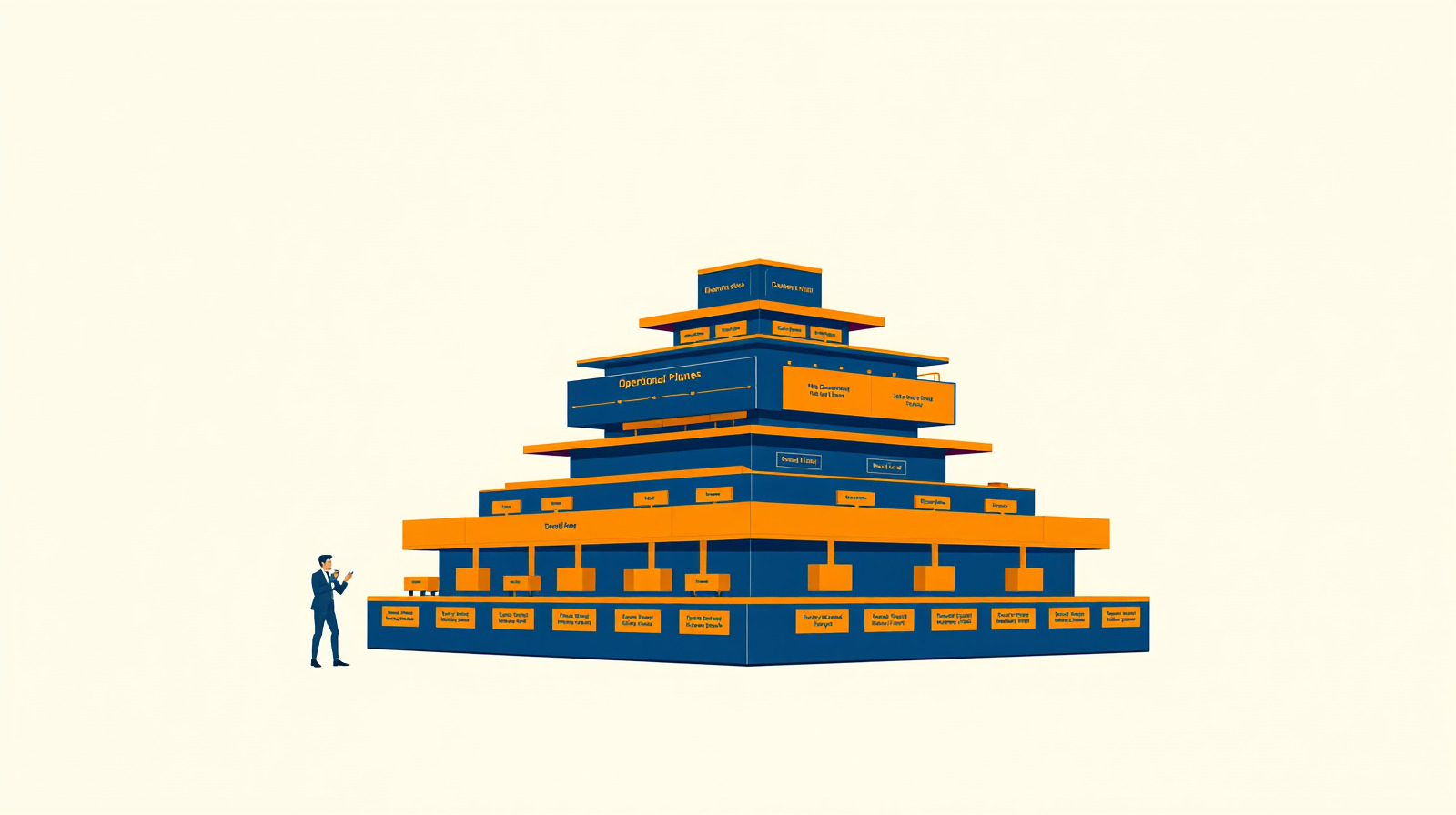
Every organization with a serious AI agenda has a strategy document. Most have a board presentation showing the use case portfolio and the projected business impact. Fewer have anyone who can tell you who is accountable for delivering it. Strategy is easy to produce. A good consulting firm can give you one in six weeks. What a consulting firm cannot give you — and what the strategy document never contains — is the operating model. The structure of decision rights, team responsibilities, budget flows, and governance rhythms that turns the document into delivery. The uncomfortable reality is that most enterprise AI programs stall not because the strategy was wrong but because the organization was never set up to execute it. The strategy outlines where the enterprise wants to go. The operating model is the infrastructure that makes going there possible. I've run large AI programs and advised others across financial services, retail, and logistics. The failure pattern is remarkably consistent. A well-funded program, technically capable people, genuine executive sponsorship — and then the model gets built, lands on someone's desk, and stays there because nobody agreed on who owns it. The four components that actually matter An AI operating model has four moving parts. When any one of them is missing or unclear, the program either stalls or delivers locally but can't scale. Decision rights. Who decides which use cases get prioritized? Who approves the data used for training? Who can pause or decommission a model in production? These sound like obvious questions. They're almost never explicitly answered in program design. The result is either decision-making by committee — slow, risk-averse, disconnected from delivery — or decision-making by default, where whoever is loudest or whoever built it ends up calling the shots. Decision rights need to be documented at three levels: strategic (which AI investments get funded), operational (how models are built and deployed), and live (what happens when a model is underperforming or producing unexpected outputs). Each level needs a named owner, not a committee. Team structure. This is where most organizations get caught by the template problem. They hire from the org chart that looks right on paper: data scientists, ML engineers, a product manager, maybe a data engineer. Then they discover that the team configured for building models isn't the same team configured for running them in production. Building a model requires experimentation, iteration, and tolerance for work that doesn't pan out. Running a model in production requires reliability, monitoring, incident response, and a retraining cadence. Those are different jobs requiring different skills and, frequently, different people. Treating them as the same function is one of the most consistent structural mistakes I see in enterprise AI programs. Funding flow. Enterprise budgets are built for projects. A project has a defined scope, a defined cost, and an end date. AI systems aren't projects — they're products. A fraud detection model doesn't have an end date. It has a training cadence, a monitoring cost, an upgrade cycle, and an ongoing infrastructure bill. Organizations that fund AI as a series of projects hit a recurring wall: the project budget closes, the model is "done," and then nobody has budget to maintain it. Three months later, performance has drifted because nobody retrained it, and the business has lost trust in the output. Restoring that trust costs more than the maintenance would have. The budget architecture for AI needs a product model: a defined operational envelope with funding for compute, monitoring, retraining, and team continuity — not a project sign-off that treats delivery as the end of the financial commitment. Governance cadence. Most program governance is designed around the build phase: sprint reviews, milestone sign-offs, stage gates. That's appropriate during delivery. It becomes actively harmful when applied to production operations, because it treats the model as something being built rather than something being maintained. Production AI governance needs a different rhythm: regular performance reviews against defined thresholds, a process for escalating drift or anomalies, a documented retraining trigger, and a clear path for decommissioning models that have stopped working. The cadence that works for development doesn't work for operations, and organizations that don't make the switch usually find out the hard way. The three structural models and when they break Most enterprise AI programs eventually settle on one of three structural approaches. Each has failure modes that are predictable enough to plan for. The centralized Center of Excellence. A single AI team owns all development. Business units bring use cases; the CoE builds and deploys. This works when AI is new and skills are scarce — it concentrates expertise, maintains quality standards, and avoids the duplication of having every business unit solve the same technical problems independently. It breaks when it scales. A centralized CoE becomes a bottleneck. Business units queue use cases, wait months for delivery, and eventually work around the CoE by hiring their own data scientists and building their own models in isolation. You end up with both the overhead of a centralized team and the inconsistency of a federated one. The federated model. Each business unit builds its own AI capability. This works for organizations where business units are large enough to sustain dedicated AI teams and where use cases are genuinely domain-specific enough that centralization doesn't add value. It breaks on consistency and standards. Without a central function maintaining governance standards, data policies, model documentation requirements, and quality controls, every business unit ends up with its own approach. The result is a portfolio of AI systems you can't audit, can't compare, and can't migrate when the underlying infrastructure needs upgrading. The hybrid model. A small central function maintains standards, infrastructure, and shared tooling. Business units own their use cases and have dedicated AI talent, but operate within a defined governance framework. This is the approach that scales best in most large enterprises. It breaks on design. The center-to-spoke relationship is frequently underspecified. Who sets the standards, and what authority does the center have to enforce them? When a business unit builds something that doesn't meet standards, what happens? Without clear answers, the hybrid model drifts toward either a weak CoE that everyone ignores or a governance overhead that slows everything down without adding value. The accountability gap The question I ask in almost every program review I run: who owns the model when it's in production? The usual answer is some combination of the team that built it, the business unit that requested it, and the platform team that runs the infrastructure. Which means nobody. A production AI model needs a named owner — a person accountable for its performance, its monitoring, its retraining cadence, and the decision to decommission it if it stops working. That's a product ownership function, not a data science function. It requires someone who can read a performance dashboard, understand what the numbers mean for the business, and escalate when thresholds are breached. Most organizations don't hire for this. They build the model, hand it to whoever is closest, and hope performance holds. It rarely does for long. The transition from project to product Moving from project-based to product-based AI delivery is less a structural change than a mindset and funding change. The hardest part is usually the budget model. Project teams have a natural end: delivery. Product teams don't. Building the internal case for sustaining an AI model in production — when the interesting work of building it is done — requires framing it as infrastructure, not initiative. Infrastructure has maintenance budgets. Initiatives have end dates. The second hardest part is the handoff. Most programs build toward a transition from the build team to "the business" or "operations." That handoff is where most programs fail to maintain what they built. The receiving team rarely has the context, skills, or budget to run what's been handed to them. The alternative is not a clean handoff. It's a gradual transition: the build team shifts focus toward operations while the operational capability is grown alongside the model itself. It costs more during the build phase. It dramatically reduces the production failure rate, and it produces a team that actually understands what it's running. That understanding is worth more than it sounds. An operations team that doesn't know why a model does what it does cannot respond effectively when it stops doing it. And models always, eventually, stop doing what they were designed to do. The question is whether anyone notices in time.
Read full article