How to Build an AI Data Governance Framework Executives Will Actually Use
- 05 Mins read
Data governance frameworks are one of the most reliably underused artifacts in enterprise AI programs. They get built, often with genuine care and significant effort, and then they get reviewed annually by the compliance team and consulted by nobody else.
The problem is not usually the content. The problem is who the framework is written for and how it connects — or fails to connect — to the decisions that actually need to get made.
Most data governance frameworks are written for compliance teams. They are thorough, they are precise, and they are not the thing an executive reaches for when they need to decide whether a specific AI use case is appropriate. They are also not the thing a business line manager references when they are trying to figure out whether they can use a new AI tool with client data.
An AI data governance framework that actually works does two things differently. It is designed around the decisions that need to happen, not the principles that are supposed to guide them. And it has ownership that is connected to actual authority.
Why most frameworks fail to produce decisions
The typical AI data governance framework includes a set of principles: data minimization, purpose limitation, appropriate security, transparency in AI use. These principles are correct. They do not produce decisions.
When a business line manager wants to deploy an AI tool for a new use case, they need to know: is this approved, under what conditions, and who decides if I am not sure? A principles document does not answer any of those questions. The manager does one of two things: they either escalate to a committee that meets monthly and respond six weeks later, or they proceed without asking because the approval path is too unclear to bother.
The outcome of the first path is governance that moves at the wrong pace. The outcome of the second is governance that does not exist in practice.
An effective AI data governance framework is built backwards from the decisions that need to get made: what use cases are pre-approved, what use cases require individual review, who conducts that review, and what criteria they apply. The principles inform the criteria, but the framework is organized around the decision structure.
The ownership model that actually works
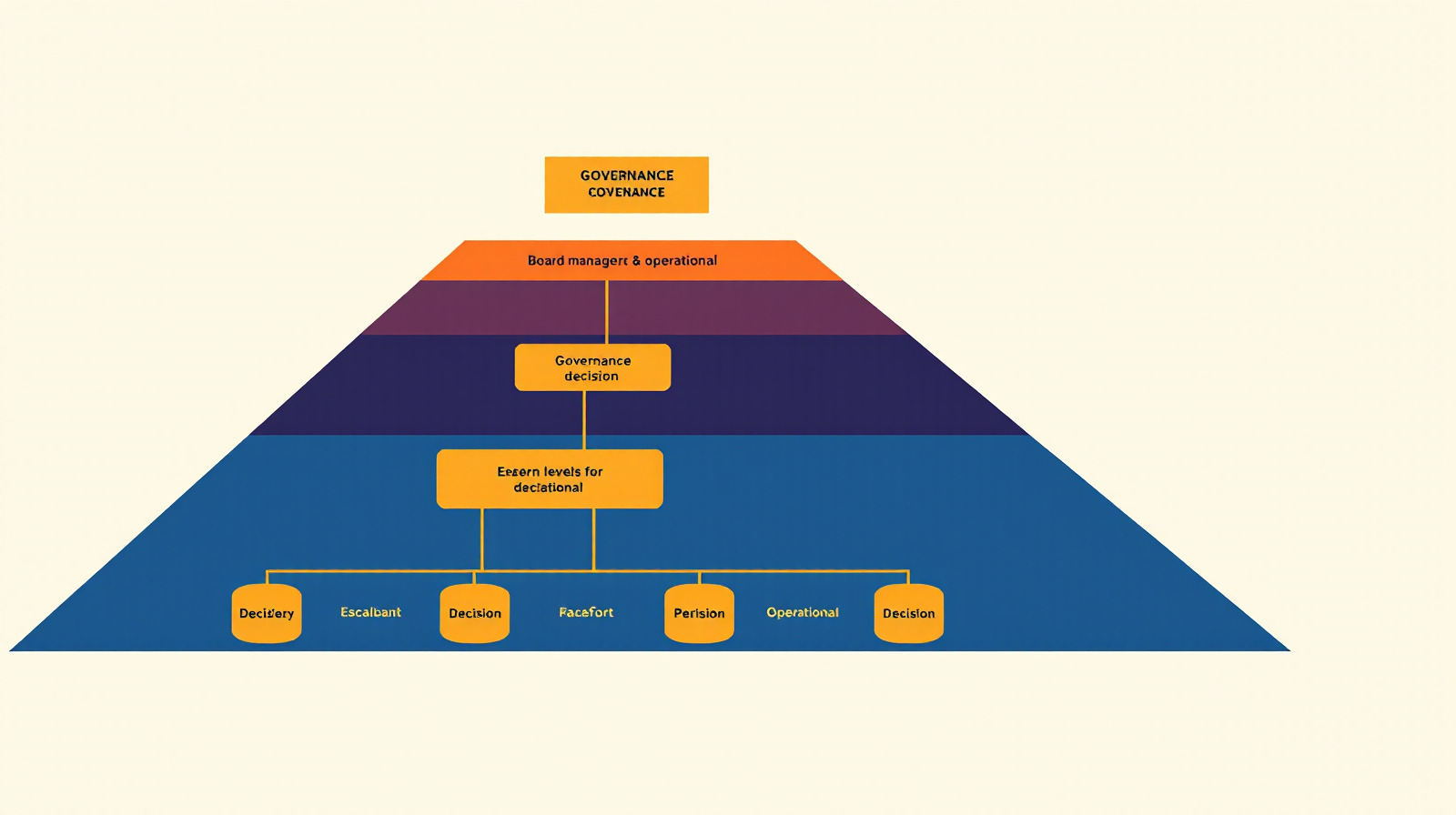
Data governance for AI requires ownership at three levels, and the levels need to be connected.
Executive sponsor. One member of the executive team owns AI data governance as a responsibility, not as a title. This person ensures the framework is consistent with the organization’s risk appetite, resolves escalations that the operational governance structure cannot, and is accountable to the board for the organization’s AI data governance posture. Without this person, governance decisions pile up in committee and do not get resolved.
Operational owners. The CIO and CTO share operational ownership of the framework — the CIO for data classification, access controls, and compliance with data protection obligations; the CTO for AI system architecture, vendor data terms, and technical controls. These two need to work together consistently, which means shared visibility into AI deployments and a clear division of the decisions that sit with each.
Data owners by domain. For each major data category — client data, HR data, financial data, legal material — a specific owner is accountable for decisions about AI use in that domain. This person is not the CIO or CTO; they are typically the head of the business function that owns the data. They approve use cases, review exceptions, and escalate issues that require executive judgment.
The framework only works if these three levels are connected through a clear escalation structure and meet at a cadence that matches the pace of AI deployment decisions in the organization.
The decision structure: the practical center of the framework
The most useful component of any AI data governance framework is a decision matrix: which use cases and data types fall into which approval category.
Pre-approved. Use cases that are within defined parameters and require no additional review before deployment. These should be clearly specified: which AI tools, with which data categories, under which conditions, are automatically approved. The goal is to move the routine decisions out of the governance process entirely, so the governance process can focus on the non-routine ones.
Expedited review. Use cases that require review but can be processed within a defined short timeframe — five to ten business days. The review criteria should be pre-specified so that the review is a check against criteria rather than a fresh analysis from first principles. Most new use cases should fall here.
Full governance review. Use cases involving novel data categories, significant regulatory complexity, or high-sensitivity data that require a more thorough assessment. These should be rare if the pre-approved and expedited categories are well-designed.
Prohibited. Use cases that are not permitted under any conditions, or not permitted until specific controls are in place. Making these explicit removes them from the case-by-case decision space.
The matrix should be a reference document that people actually consult — short, decision-oriented, updated regularly as the landscape changes.
What makes governance visible to executives
Executives do not engage with governance frameworks through documentation. They engage through metrics, through escalations, and through the questions they ask in governance meetings.
The metrics that matter: how many AI use case reviews were completed in the period, at what pace, with what outcomes? How many active AI deployments have been reviewed under the framework and how many have not? What is the current status of high-risk AI deployments relative to the framework’s requirements?
These are the questions the executive sponsor should be asking at governance review meetings. If the CIO cannot answer them, the governance program does not have adequate visibility into what is happening.
The escalation structure is equally important. When a business line manager hits a governance decision they cannot make at their level, the path to getting an answer needs to be fast and clear. A governance framework that requires a monthly committee meeting to resolve a time-sensitive deployment decision is not fit for the pace at which AI deployment happens.
Keeping it current without making it a burden
AI data governance frameworks go stale quickly. Vendor terms change. New AI capabilities create new use cases. Regulatory guidance evolves. The framework needs a maintenance mechanism that keeps it current without requiring a major review process every time something changes.
The practical approach: designate the operational owners — CIO and CTO — as responsible for maintaining the framework, with a quarterly review cycle and a clear process for minor updates between cycles. The executive sponsor reviews major changes. The board sees an annual summary.
The review cycle for specific elements of the framework should be driven by trigger events — a new major AI deployment, a significant regulatory development, a governance incident — rather than purely by calendar.
What to take from this
- Build the framework around the decisions that need to happen, not the principles that inform them. A decision matrix that tells people what is pre-approved, what needs review, and what is prohibited is more useful than a comprehensive principles document.
- Name an executive sponsor with genuine accountability, not an oversight committee with diffuse responsibility. Committees defer decisions; sponsors make them.
- Data owners by domain need to be part of the governance structure. The head of the business function that owns the data is better positioned to make AI use case decisions for that domain than a central technology function.
- Build governance metrics into the executive review agenda. If the CIO cannot answer questions about active AI deployment coverage at a governance meeting, the oversight is insufficient.
- The escalation path from a business line manager to a governance decision needs to be fast enough to match the pace of AI deployment. If the answer takes six weeks, managers will stop asking.
The organizations with effective AI data governance are not the ones with the most comprehensive frameworks. They are the ones that have built governance around how decisions actually get made in their organization, rather than how they are supposed to get made according to the framework.