
- 01 May, 2026
The AI Operating Model Most Enterprises Haven't Built Yet
Every organization with a serious AI agenda has a strategy document. Most have a board presentation showing the use case portfolio and the projected business impact. Fewer have anyone who can tell you who is accountable for delivering it. Strategy is easy to produce. A good consulting firm can give you one in six weeks. What a consulting firm cannot give you — and what the strategy document never contains — is the operating model. The structure of decision rights, team responsibilities, budget flows, and governance rhythms that turns the document into delivery. The uncomfortable reality is that most enterprise AI programs stall not because the strategy was wrong but because the organization was never set up to execute it. The strategy outlines where the enterprise wants to go. The operating model is the infrastructure that makes going there possible. I've run large AI programs and advised others across financial services, retail, and logistics. The failure pattern is remarkably consistent. A well-funded program, technically capable people, genuine executive sponsorship — and then the model gets built, lands on someone's desk, and stays there because nobody agreed on who owns it. The four components that actually matter An AI operating model has four moving parts. When any one of them is missing or unclear, the program either stalls or delivers locally but can't scale. Decision rights. Who decides which use cases get prioritized? Who approves the data used for training? Who can pause or decommission a model in production? These sound like obvious questions. They're almost never explicitly answered in program design. The result is either decision-making by committee — slow, risk-averse, disconnected from delivery — or decision-making by default, where whoever is loudest or whoever built it ends up calling the shots. Decision rights need to be documented at three levels: strategic (which AI investments get funded), operational (how models are built and deployed), and live (what happens when a model is underperforming or producing unexpected outputs). Each level needs a named owner, not a committee. Team structure. This is where most organizations get caught by the template problem. They hire from the org chart that looks right on paper: data scientists, ML engineers, a product manager, maybe a data engineer. Then they discover that the team configured for building models isn't the same team configured for running them in production. Building a model requires experimentation, iteration, and tolerance for work that doesn't pan out. Running a model in production requires reliability, monitoring, incident response, and a retraining cadence. Those are different jobs requiring different skills and, frequently, different people. Treating them as the same function is one of the most consistent structural mistakes I see in enterprise AI programs. Funding flow. Enterprise budgets are built for projects. A project has a defined scope, a defined cost, and an end date. AI systems aren't projects — they're products. A fraud detection model doesn't have an end date. It has a training cadence, a monitoring cost, an upgrade cycle, and an ongoing infrastructure bill. Organizations that fund AI as a series of projects hit a recurring wall: the project budget closes, the model is "done," and then nobody has budget to maintain it. Three months later, performance has drifted because nobody retrained it, and the business has lost trust in the output. Restoring that trust costs more than the maintenance would have. The budget architecture for AI needs a product model: a defined operational envelope with funding for compute, monitoring, retraining, and team continuity — not a project sign-off that treats delivery as the end of the financial commitment. Governance cadence. Most program governance is designed around the build phase: sprint reviews, milestone sign-offs, stage gates. That's appropriate during delivery. It becomes actively harmful when applied to production operations, because it treats the model as something being built rather than something being maintained. Production AI governance needs a different rhythm: regular performance reviews against defined thresholds, a process for escalating drift or anomalies, a documented retraining trigger, and a clear path for decommissioning models that have stopped working. The cadence that works for development doesn't work for operations, and organizations that don't make the switch usually find out the hard way. The three structural models and when they break Most enterprise AI programs eventually settle on one of three structural approaches. Each has failure modes that are predictable enough to plan for. The centralized Center of Excellence. A single AI team owns all development. Business units bring use cases; the CoE builds and deploys. This works when AI is new and skills are scarce — it concentrates expertise, maintains quality standards, and avoids the duplication of having every business unit solve the same technical problems independently. It breaks when it scales. A centralized CoE becomes a bottleneck. Business units queue use cases, wait months for delivery, and eventually work around the CoE by hiring their own data scientists and building their own models in isolation. You end up with both the overhead of a centralized team and the inconsistency of a federated one. The federated model. Each business unit builds its own AI capability. This works for organizations where business units are large enough to sustain dedicated AI teams and where use cases are genuinely domain-specific enough that centralization doesn't add value. It breaks on consistency and standards. Without a central function maintaining governance standards, data policies, model documentation requirements, and quality controls, every business unit ends up with its own approach. The result is a portfolio of AI systems you can't audit, can't compare, and can't migrate when the underlying infrastructure needs upgrading. The hybrid model. A small central function maintains standards, infrastructure, and shared tooling. Business units own their use cases and have dedicated AI talent, but operate within a defined governance framework. This is the approach that scales best in most large enterprises. It breaks on design. The center-to-spoke relationship is frequently underspecified. Who sets the standards, and what authority does the center have to enforce them? When a business unit builds something that doesn't meet standards, what happens? Without clear answers, the hybrid model drifts toward either a weak CoE that everyone ignores or a governance overhead that slows everything down without adding value. The accountability gap The question I ask in almost every program review I run: who owns the model when it's in production? The usual answer is some combination of the team that built it, the business unit that requested it, and the platform team that runs the infrastructure. Which means nobody. A production AI model needs a named owner — a person accountable for its performance, its monitoring, its retraining cadence, and the decision to decommission it if it stops working. That's a product ownership function, not a data science function. It requires someone who can read a performance dashboard, understand what the numbers mean for the business, and escalate when thresholds are breached. Most organizations don't hire for this. They build the model, hand it to whoever is closest, and hope performance holds. It rarely does for long. The transition from project to product Moving from project-based to product-based AI delivery is less a structural change than a mindset and funding change. The hardest part is usually the budget model. Project teams have a natural end: delivery. Product teams don't. Building the internal case for sustaining an AI model in production — when the interesting work of building it is done — requires framing it as infrastructure, not initiative. Infrastructure has maintenance budgets. Initiatives have end dates. The second hardest part is the handoff. Most programs build toward a transition from the build team to "the business" or "operations." That handoff is where most programs fail to maintain what they built. The receiving team rarely has the context, skills, or budget to run what's been handed to them. The alternative is not a clean handoff. It's a gradual transition: the build team shifts focus toward operations while the operational capability is grown alongside the model itself. It costs more during the build phase. It dramatically reduces the production failure rate, and it produces a team that actually understands what it's running. That understanding is worth more than it sounds. An operations team that doesn't know why a model does what it does cannot respond effectively when it stops doing it. And models always, eventually, stop doing what they were designed to do. The question is whether anyone notices in time.
Read full article
- 30 Apr, 2026
The AI Business Case: Why the Numbers Rarely Survive Reality
Every AI investment proposal I have reviewed in the past three years has had a compelling financial case. The productivity gains are specific, the cost savings are quantified, the revenue uplift is modeled, and the payback period is well inside what the investment committee would find reasonable. Most of them have also been wrong — not dishonestly, but systematically. The assumptions that make the numbers look good are made in a particular direction, and they tend to break in a particular direction too. The CFO who understands the pattern can ask the right questions before the commitment rather than investigating the variance afterward. How AI business cases are typically built The structure of an AI business case is generally one of three things: productivity improvement, cost reduction, or revenue enhancement. Often two of those, sometimes all three. Productivity cases are the most common. The model identifies a set of tasks that employees currently spend time on, estimates the reduction in time per task from AI assistance, multiplies by headcount and average cost, and arrives at a total productivity benefit. This benefit is then either translated into cost savings (if the productivity gain enables headcount reduction) or revenue capacity (if the freed-up time is assumed to generate additional output). Cost reduction cases focus on replacing a specific cost line with a lower-cost AI equivalent: automated processing replacing manual review, AI-assisted support reducing support ticket volume, AI-generated content reducing external agency spend. Revenue enhancement cases are the hardest to validate. They typically model increased conversion from better personalization, faster sales cycles from AI-assisted prospecting, or improved retention from AI-driven customer engagement. All three structures make assumptions that deserve scrutiny. The productivity case: where it falls apart The productivity benefit in an AI business case is almost always calculated as: time saved per task × number of tasks × cost per hour. The output looks rigorous because the components are quantifiable. The problem is in the assumptions embedded in each component. Time saved per task. Productivity estimates for AI tools tend to be derived from vendor-provided benchmarks, early adopter case studies, or lab conditions that do not reflect the complexity of the target organization's actual tasks. In practice, AI tools perform better on well-structured, high-volume, low-complexity tasks and worse on tasks that require organizational context, judgment, or integration with messy internal data. The business case rarely distinguishes between task types. Realization of saved time as economic value. The larger problem: even if the time savings are real, they do not automatically translate into economic value. An employee who saves an hour a day through AI assistance does not produce an extra unit of output or enable a headcount reduction unless the organization deliberately redirects that time. Most organizations do not, and the time is absorbed as slack rather than captured as value. I have seen productivity estimates that modeled 30% efficiency improvement across a 500-person workforce translate into an economic case requiring either 150 fewer employees or a 30% increase in output volume. Neither happened, because nobody had a plan to actually capture the freed capacity. Change in task volume over time. As the AI system is used and trusted, the scope of what it is used for often expands, absorbing the productivity savings in handling more work at the same cost rather than handling the same work at lower cost. The cost reduction case: where it falls apart Cost reduction cases tend to be cleaner in structure but optimistic in two specific ways. Implementation and operating costs. The business case benefits are usually calculated net of license costs but not fully net of implementation, integration, change management, training, and ongoing operational costs. A cost reduction case that shows net savings of $2M per year before accounting for $1.5M of implementation and $600K of annual operating costs is not a savings case — it is marginally break-even in the first three years with significant execution risk. Partial automation economics. Many AI automation cases are built on the premise that the AI handles a defined portion of a task, reducing human effort for the remainder. The economics of partial automation are frequently miscalculated because the human labor required for oversight, exception handling, and quality review is underestimated. A process where AI handles 80% of cases automatically and humans handle the remaining 20% does not cost 20% of the original — it often costs 40-50% because the exception cases require more effort per case than the routine ones, and the oversight of the automated cases is not free. The revenue enhancement case: where it falls apart Revenue enhancement cases should be held to the highest scrutiny because they are the hardest to falsify before the investment and the easiest to attribute other causes to if they fail. The specific assumption to challenge: revenue enhancement from AI is almost always modeled as an incremental benefit on top of the existing business trajectory. If the sales cycle is improving anyway, some portion of the improvement is attributed to AI. If retention is improving, some portion is attributed to AI personalization. The counterfactual — what would have happened without the AI — is almost never established. Ask how the business case quantifies the incremental contribution of AI specifically, as opposed to other factors moving in the same direction. If the answer is that it is impossible to isolate, the revenue numbers in the business case are assumptions dressed as projections. What a CFO should specifically challenge The realization rate. How will the organization actually capture the productivity benefit? Is there a plan to redeploy freed capacity, or is the assumption that it translates automatically into value? If there is no explicit realization plan, discount the productivity benefit substantially. The fully loaded cost. Have implementation, integration, change management, and ongoing operational costs been included? If the cost side is license fees only, the payback period is understated. The task mix. What proportion of the tasks in scope are well-structured and repetitive versus context-dependent and complex? The business case should show different adoption rates for different task types, not a single adoption rate applied across the board. The timeline assumptions. AI implementations almost always take longer and cost more than the business case assumes. How sensitive is the payback period to a six-month delay in deployment, or to adoption rates that are 30% lower than modeled in year one? The pilot evidence. Is there a pilot or proof-of-concept that demonstrates the modeled performance in the specific organizational context? Business cases built on vendor benchmarks without organizational validation should be required to run a pilot before commitment. What to take from thisProductivity benefits in AI business cases often model time savings accurately but fail to account for how that time will actually be captured as economic value. A plan for realization is as important as the estimate. Cost reduction cases frequently understate implementation, integration, and ongoing operational costs. Get the fully loaded cost before evaluating payback period. Partial automation economics are usually miscalculated. Exception handling and oversight are not free; account for them explicitly. Revenue enhancement cases without an established counterfactual are projections dressed as analysis. Require a measurement approach before the investment. Require a pilot with organizational data before full commitment on large AI investments. Vendor benchmarks do not predict performance in a specific organizational context.The CFOs who navigate AI investment well are not the ones who apply the highest discount rates to AI business cases. They are the ones who ask the specific questions that distinguish a credible case from a well-presented one — and who require the answers before signing off.
Read full article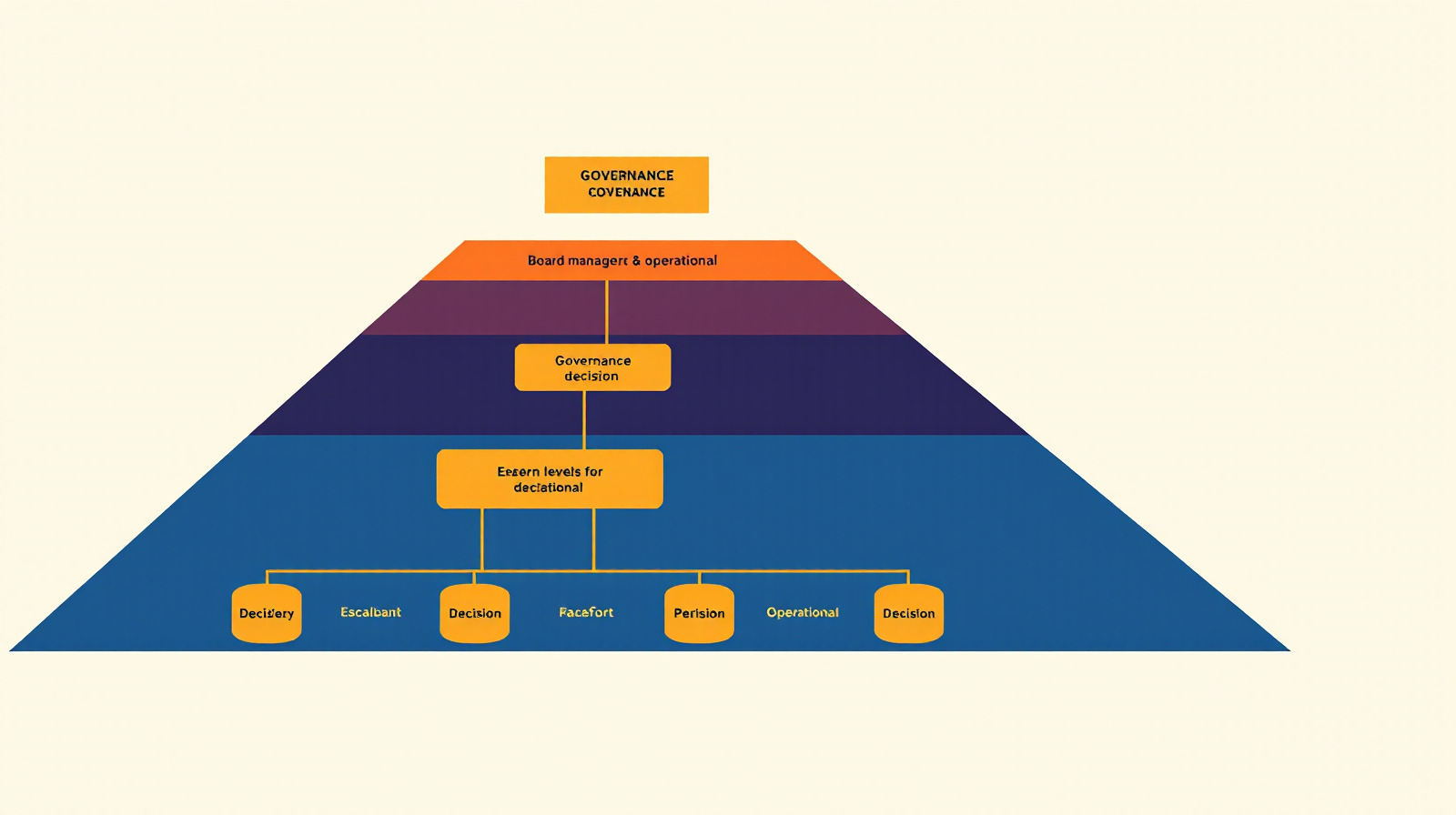
- 28 Apr, 2026
How to Build an AI Data Governance Framework Executives Will Actually Use
Data governance frameworks are one of the most reliably underused artifacts in enterprise AI programs. They get built, often with genuine care and significant effort, and then they get reviewed annually by the compliance team and consulted by nobody else. The problem is not usually the content. The problem is who the framework is written for and how it connects — or fails to connect — to the decisions that actually need to get made. Most data governance frameworks are written for compliance teams. They are thorough, they are precise, and they are not the thing an executive reaches for when they need to decide whether a specific AI use case is appropriate. They are also not the thing a business line manager references when they are trying to figure out whether they can use a new AI tool with client data. An AI data governance framework that actually works does two things differently. It is designed around the decisions that need to happen, not the principles that are supposed to guide them. And it has ownership that is connected to actual authority. Why most frameworks fail to produce decisions The typical AI data governance framework includes a set of principles: data minimization, purpose limitation, appropriate security, transparency in AI use. These principles are correct. They do not produce decisions. When a business line manager wants to deploy an AI tool for a new use case, they need to know: is this approved, under what conditions, and who decides if I am not sure? A principles document does not answer any of those questions. The manager does one of two things: they either escalate to a committee that meets monthly and respond six weeks later, or they proceed without asking because the approval path is too unclear to bother. The outcome of the first path is governance that moves at the wrong pace. The outcome of the second is governance that does not exist in practice. An effective AI data governance framework is built backwards from the decisions that need to get made: what use cases are pre-approved, what use cases require individual review, who conducts that review, and what criteria they apply. The principles inform the criteria, but the framework is organized around the decision structure. The ownership model that actually works Data governance for AI requires ownership at three levels, and the levels need to be connected. Executive sponsor. One member of the executive team owns AI data governance as a responsibility, not as a title. This person ensures the framework is consistent with the organization's risk appetite, resolves escalations that the operational governance structure cannot, and is accountable to the board for the organization's AI data governance posture. Without this person, governance decisions pile up in committee and do not get resolved. Operational owners. The CIO and CTO share operational ownership of the framework — the CIO for data classification, access controls, and compliance with data protection obligations; the CTO for AI system architecture, vendor data terms, and technical controls. These two need to work together consistently, which means shared visibility into AI deployments and a clear division of the decisions that sit with each. Data owners by domain. For each major data category — client data, HR data, financial data, legal material — a specific owner is accountable for decisions about AI use in that domain. This person is not the CIO or CTO; they are typically the head of the business function that owns the data. They approve use cases, review exceptions, and escalate issues that require executive judgment. The framework only works if these three levels are connected through a clear escalation structure and meet at a cadence that matches the pace of AI deployment decisions in the organization. The decision structure: the practical center of the framework The most useful component of any AI data governance framework is a decision matrix: which use cases and data types fall into which approval category. Pre-approved. Use cases that are within defined parameters and require no additional review before deployment. These should be clearly specified: which AI tools, with which data categories, under which conditions, are automatically approved. The goal is to move the routine decisions out of the governance process entirely, so the governance process can focus on the non-routine ones. Expedited review. Use cases that require review but can be processed within a defined short timeframe — five to ten business days. The review criteria should be pre-specified so that the review is a check against criteria rather than a fresh analysis from first principles. Most new use cases should fall here. Full governance review. Use cases involving novel data categories, significant regulatory complexity, or high-sensitivity data that require a more thorough assessment. These should be rare if the pre-approved and expedited categories are well-designed. Prohibited. Use cases that are not permitted under any conditions, or not permitted until specific controls are in place. Making these explicit removes them from the case-by-case decision space. The matrix should be a reference document that people actually consult — short, decision-oriented, updated regularly as the landscape changes. What makes governance visible to executives Executives do not engage with governance frameworks through documentation. They engage through metrics, through escalations, and through the questions they ask in governance meetings. The metrics that matter: how many AI use case reviews were completed in the period, at what pace, with what outcomes? How many active AI deployments have been reviewed under the framework and how many have not? What is the current status of high-risk AI deployments relative to the framework's requirements? These are the questions the executive sponsor should be asking at governance review meetings. If the CIO cannot answer them, the governance program does not have adequate visibility into what is happening. The escalation structure is equally important. When a business line manager hits a governance decision they cannot make at their level, the path to getting an answer needs to be fast and clear. A governance framework that requires a monthly committee meeting to resolve a time-sensitive deployment decision is not fit for the pace at which AI deployment happens. Keeping it current without making it a burden AI data governance frameworks go stale quickly. Vendor terms change. New AI capabilities create new use cases. Regulatory guidance evolves. The framework needs a maintenance mechanism that keeps it current without requiring a major review process every time something changes. The practical approach: designate the operational owners — CIO and CTO — as responsible for maintaining the framework, with a quarterly review cycle and a clear process for minor updates between cycles. The executive sponsor reviews major changes. The board sees an annual summary. The review cycle for specific elements of the framework should be driven by trigger events — a new major AI deployment, a significant regulatory development, a governance incident — rather than purely by calendar. What to take from thisBuild the framework around the decisions that need to happen, not the principles that inform them. A decision matrix that tells people what is pre-approved, what needs review, and what is prohibited is more useful than a comprehensive principles document. Name an executive sponsor with genuine accountability, not an oversight committee with diffuse responsibility. Committees defer decisions; sponsors make them. Data owners by domain need to be part of the governance structure. The head of the business function that owns the data is better positioned to make AI use case decisions for that domain than a central technology function. Build governance metrics into the executive review agenda. If the CIO cannot answer questions about active AI deployment coverage at a governance meeting, the oversight is insufficient. The escalation path from a business line manager to a governance decision needs to be fast enough to match the pace of AI deployment. If the answer takes six weeks, managers will stop asking.The organizations with effective AI data governance are not the ones with the most comprehensive frameworks. They are the ones that have built governance around how decisions actually get made in their organization, rather than how they are supposed to get made according to the framework.
Read full article
- 24 Apr, 2026
Why AI Proof of Concepts Keep Failing to Reach Production
The statistic that gets quoted most often in enterprise AI discussions is that somewhere between 70 and 85 percent of AI proof of concepts never make it to production. The number varies by survey and by how you define "production," but the underlying phenomenon is consistent enough that I've stopped being surprised by it. What still surprises me is how the failure gets explained. The common story is that POCs fail because of technical complexity — the model doesn't generalize, the infrastructure isn't ready, the data is messier than expected. Sometimes that's true. More often, it isn't. The POC-to-production gap is primarily a governance failure, a funding failure, and an ownership failure. The technical problems are real but solvable. The structural problems are what actually kill programs. Why POC success can make things harder There's a version of this problem that's counterintuitive. A POC that performs well in a controlled environment can actually make production harder, not easier. When a POC succeeds, it generates expectations anchored to demonstration conditions. The data was curated. The use case was selected because it would work. The team was focused exclusively on making the thing perform. Production conditions are none of those things. The data is messier, the scope is broader, the team is split across other priorities, and the infrastructure needs to support real volumes and real latency requirements. The expectation gap between a successful POC and a production deployment is where a lot of programs die quietly. The business saw the demo, was impressed, approved funding — and then watched the production timeline slip while the performance benchmarks eroded. By the time the program is asking for additional time and budget, the credibility built by the POC has been spent. The five root causes Funding cliff. Most POCs are funded as experiments. A fixed budget, a fixed timeline, a specific deliverable: a working model that demonstrates feasibility. When the POC ends, the project budget closes. The team moves on to the next experiment. Production deployment isn't a continuation of the POC — it's a different program with different requirements and a different cost structure. Data infrastructure needs to handle production volumes. The model needs serving infrastructure. Monitoring needs to be built. Documentation needs to exist. Integration with production systems needs to happen. None of this was in the POC budget. Organizations that fund AI as a series of POCs never get to production. The model sits in a notebook, technically demonstrated, operationally useless. Ownership vacuum. A POC has natural owners: the data science team that built it and the business function that requested it. When the POC ends, ownership becomes ambiguous. The data science team has moved on. The business function owns the use case but not the model. IT owns the infrastructure but not the model logic. Nobody owns the whole thing. A production model needs a named owner — someone accountable for performance monitoring, retraining cadence, incident response, and the decision to decommission if performance degrades. That person and role need to be identified before the POC even starts, not after. Infrastructure gap. Most enterprise AI infrastructure decisions get deferred until after a POC has proven the concept. The logic is reasonable — don't invest in infrastructure for something that might not work. The consequence is that every successful POC immediately runs into a queue of infrastructure decisions that take months to resolve: model serving, feature engineering pipelines, data integration, security review, cloud provisioning. The gap between "POC complete" and "infrastructure ready for production deployment" is often six to twelve months in large enterprises. During that window, the team disperses, the business loses momentum, and the case for continued investment weakens. Governance mismatch. Enterprise governance processes were designed for traditional software. They weren't designed for AI systems that change over time, produce probabilistic outputs, and can generate systematically wrong answers without producing an error code. When a production-bound AI model hits the enterprise change management process, risk assessment, security review, and compliance sign-off, it often encounters requirements that weren't anticipated in the POC design. The model may need to be redesigned to meet explainability requirements. Data sourcing may need to change to meet compliance requirements. The security review may identify risks that require architectural changes. Each of these adds time and cost the original program budget didn't include. Success metric drift. POCs are typically evaluated on model performance metrics: accuracy, F1, AUC. Production is evaluated on business metrics: decisions improved, costs reduced, revenue generated. Those are different measurements, and the relationship between them is not guaranteed. A model that achieves 92% accuracy in testing may produce business outcomes that are difficult to attribute to the model specifically. Or the business metric assumed in the business case turns out to be hard to measure in practice. When production performance can't be clearly connected to business value, the investment becomes hard to defend. What production-ready actually means "Production-ready" in enterprise AI means more than a model that performs well on test data. It means: A serving infrastructure that handles the required throughput at the required latency, with defined behavior when the model fails or is unavailable. A monitoring system that tracks performance against defined thresholds and alerts when drift occurs. A retraining process that is documented, tested, and owned. An audit trail that captures model inputs, outputs, and decisions for the retention period required by relevant regulations. An explainability layer where required by regulation or business process. A decommissioning plan. Most POCs deliver none of these. Getting from a POC to a production-ready system is the bulk of the actual engineering work — which is why the common estimate that a POC represents 10 to 20 percent of the total production cost is roughly right in most programs I've seen. The playbook The decisions that close the gap need to happen before the POC starts, not after it proves the concept. Define the production requirements before building the POC. What infrastructure will the production system run on? What monitoring will it require? What governance processes will it need to pass? Building the POC against these requirements costs slightly more upfront and dramatically reduces the cost of moving to production. Name the production owner before the POC is approved. Who will own this model when it's live? What role is that person in? What resources will they have? If there's no good answer, the POC shouldn't start — because even if it succeeds, there's nowhere for it to go. Fund build-to-production, not build-to-POC. The funding model needs to include the full cost of production deployment: infrastructure, integration, monitoring, governance sign-offs, and the first year of operational costs. Approving POC budgets without production budgets produces a portfolio of successful experiments with nowhere to go. Run production governance in parallel with POC development. Security review, compliance assessment, and explainability requirements shouldn't be surprises at the end of the POC. They should be running in parallel so the production path is clear before the model is ready to move. None of this is complicated. Most organizations know it's the right approach. The reason it doesn't happen is that POCs are easier to approve than production programs — they're smaller, faster, and lower risk. The problem is that a series of successful POCs is not an AI program. It's an expensive set of demonstrations. The gap between those two things is what most enterprises are currently living in.
Read full article
- 21 Apr, 2026
What a Data Breach Looks Like When AI Is in the Middle of It
Most enterprise data breach response plans were written for a specific type of incident: unauthorized external access to a database, a misconfigured cloud storage bucket, a stolen credential, a ransomware attack. The response playbook is well understood. Contain the breach, assess the scope, notify regulators, notify affected individuals, remediate the vulnerability. When an AI system is in the middle of a breach — as a vector, as an amplifier of exposure, or as the primary source of the incident — the playbook breaks down in several places. The scope assessment is harder. The cause is less obvious. The regulatory notification may require analysis the organization has not done. And the communications with affected parties need to account for AI involvement in ways that the standard template does not anticipate. Organizations that have AI systems in production and have not updated their incident response plans are carrying risk they have not quantified. The ways AI changes the breach scenario AI as a vector. A prompt injection attack — where malicious content in the AI system's input causes the system to execute unintended actions — is a category of attack that did not exist before AI systems were connected to organizational data. The technical mechanics are different from a SQL injection or a credential attack, but the organizational response involves the same triage: what did the attacker access, what did they exfiltrate, what actions did the AI system take on their behalf? Prompt injection is not theoretical. It has been demonstrated against production AI systems across multiple vendors. Organizations that have not evaluated their AI systems against this class of attack have a gap in their security assessment. AI as an amplifier. An attacker who compromises credentials to an account with AI system access may be able to extract substantially more information than they could from the underlying data systems alone. The AI system's ability to query, synthesize, and summarize across data sources means that a single compromised session can produce outputs equivalent to weeks of manual data extraction. The scope of a breach involving AI access is likely to be larger than the scope of a breach involving equivalent access to the underlying data without AI. This matters for the scope assessment, for regulatory notification thresholds, and for the volume of affected records. AI as the source. Misconfigurations in AI systems — incorrectly permissioned data access, insecure output handling, improperly sandboxed tool use — can themselves cause data exposure without any external attacker. An AI system that surfaces information it should not have had access to in response to a user query, or that exposes data through an incorrectly configured output channel, has caused a data exposure incident even in the absence of a security breach. These incidents are less dramatic than external attacks but potentially more common. And they are harder to detect because the behavior looks like normal AI system use rather than an anomalous external access pattern. Where the standard response plan fails Scope assessment. The standard scope assessment for a data breach identifies which records were accessed. When an AI system was involved, the relevant question is not which records were accessed but which outputs were generated — what did the AI synthesize from the records it could reach, and what information was contained in those outputs? This is a harder problem. AI outputs are not automatically logged in the way that database queries are. The organization may not have complete records of what the AI system produced during the breach window. Reconstructing the scope requires different methods than a traditional database access log analysis. Cause determination. Traditional breaches have identifiable technical causes: a vulnerability, a misconfigured permission, a phishing attack. AI incidents often have more diffuse causes — a combination of permissive access, insufficient output monitoring, and system behavior that was technically within parameters but produced an unintended result. Root cause analysis for AI incidents requires understanding of the AI system's architecture and behavior that most incident response teams do not have. Regulatory notification. Data breach notification requirements typically specify notification timelines and the content of notifications. When an AI system is involved, determining what categories of personal data were exposed requires understanding what the AI could access and what it may have surfected — an analysis that takes longer and requires more specialized input than a direct database access log review. Communication with affected parties. Breach notification communications are standardized around the concept of "your data was accessed by an unauthorized party." When an AI system was the mechanism, the communication needs to explain something more complex: what the AI system could access, what it may have produced, and why that creates risk for the affected individual. Most breach communication templates are not equipped for this. What the CFO and CIO need to prepare now Update the incident response plan. The plan needs to include AI-specific scenarios: prompt injection, AI-amplified credential breach, misconfiguration-driven data exposure. Each scenario should have a defined response team (which needs to include AI system expertise), assessment methodology, and escalation path. Establish AI audit logging requirements. If the organization does not have comprehensive logging of AI system queries and outputs, it cannot conduct a complete scope assessment for an AI-involved incident. The logging requirement needs to be part of AI system deployment standards, not something added after an incident. Define who owns AI incidents. Traditional breach response has clear ownership — typically the CISO and legal team with CFO involvement for material incidents. AI incidents may involve technical characteristics the CISO team does not have expertise in. Define who the AI-specific escalation path involves and ensure that person or team is part of incident response planning. Test the plan. Incident response plans for traditional breaches are tested through tabletop exercises. AI-specific scenarios should be part of the tabletop exercise inventory. The scenario of an AI system producing outputs it should not have, or being used as a vector by an attacker, is sufficiently different from traditional scenarios to warrant explicit testing. Understand regulatory notification requirements. Check whether the data protection officer's understanding of notification thresholds and timelines accounts for AI-involved incidents. In particular: the scope determination for an AI breach may take longer than for a traditional breach, and the notification timeline starts from discovery of the breach, not from completion of scope determination. What to take from thisUpdate the incident response plan to include AI-specific scenarios before an incident occurs. The scenarios are different enough from traditional breaches to require explicit planning. Require comprehensive logging of AI system queries and outputs as a deployment standard. Without it, scope assessment for an AI-involved incident is incomplete. Define AI-specific escalation paths within the incident response structure. The expertise required to assess an AI incident is different from traditional breach response expertise. Test AI breach scenarios in tabletop exercises. The behavior of an AI system during and after an attack is counterintuitive enough to warrant practice. The scope of an AI-amplified breach is likely larger than an equivalent breach without AI involvement. Build this into the material incident threshold assessment.The organizations that handle AI-involved incidents well are not the ones that were lucky enough to avoid them. They are the ones that updated their preparedness before the first incident, so that when it happened — and it will happen — the response was organized rather than improvised.
Read full article
- 17 Apr, 2026
Enterprise ML Model Selection: How to Choose Without Getting It Wrong
Every enterprise ML project I've seen go wrong had one thing in common: the team picked the model before they understood the problem. Not the business problem — they usually had that written down somewhere. I mean the operational problem: what does production actually look like, who consumes the output, what happens when the model is wrong, and what does the organisation's tolerance for that look like. Model selection in enterprise settings is treated, too often, as a technical decision. The data scientists run a few benchmarks, the most accurate model wins, and the project moves forward. Six months later the model is sitting in a notebook because no one can explain its outputs to the risk committee, or it's running too slowly at inference to be useful, or it requires a retraining cadence no one budgeted for. This is the article I wish existed when I was doing this work early in my career. It's not about which model architecture is theoretically best for a given data type. It's about how to think through the selection decision in a way that holds up when the project hits the real world — regulatory scrutiny, budget conversations, operational constraints, and the thousand other things that don't appear in benchmark papers. The framework here is built from real projects, primarily in financial services, insurance, and logistics. The patterns apply more broadly. Where I've seen exceptions, I'll say so. The question you're not asking at the start Most teams start model selection by asking: what model performs best on our data? That's the third question you should ask. The first two are:What does the model's output need to do in the system it's deployed into? What are the non-negotiable constraints on how the model operates?Output requirements determine what "performance" even means. A credit risk model that predicts default probability doesn't just need to be accurate — it needs to produce a calibrated probability, because downstream systems are making threshold decisions based on it. An object detection model for warehouse automation doesn't need the highest mAP score; it needs consistent latency under 50ms with a failure mode that's recoverable. A demand forecasting model for supply chain might need interpretable feature contributions so planners can override it credibly. Once you know what the output actually needs to do, you can define a meaningful evaluation metric. Before that, you're benchmarking against a proxy that may have nothing to do with operational success. Non-negotiable constraints come in two flavors: hard and soft. Hard constraints eliminate entire model classes before you've run a single experiment. Soft constraints shape the selection decision once the hard constraints narrow the field. Common hard constraints in enterprise:Inference latency — if you need sub-100ms response in a user-facing API, large transformer models are off the table unless you have a serious serving infrastructure budget Explainability requirements — if a regulator requires feature-level explanations for every decision (common in credit, insurance underwriting, and healthcare), black-box models require an explanation layer that adds its own failure modes Data residency — if training data cannot leave a specific jurisdiction, any model requiring cloud-based training infrastructure is constrained Retraining frequency — if your data distribution shifts fast and you cannot support frequent retraining, you need a model that degrades gracefully or one that incorporates online learningThe soft constraints — deployment complexity, team familiarity, tooling compatibility — shape the shortlist once the hard constraints have done their filtering work.Why model complexity is a separate axis from model performance There's a prevailing assumption in ML that a more complex model is always better if you have enough data. In research settings, this is often true. In enterprise settings, it creates a class of problems that don't show up until the model is in production. Complexity has costs that compound over time: Debugging cost. When a complex model produces an unexpected output — a prediction that triggers an alert, a recommendation that contradicts business logic — the investigation takes longer. With a gradient boosting model, a skilled analyst can often trace the output back to specific feature values within minutes. With a deep neural network, you may be running attribution methods that give you approximate explanations, not definitive ones. Retraining cost. A neural network that takes six hours to train on a GPU cluster has a different operational footprint than a gradient boosting model that trains in twenty minutes on CPU. If your use case requires weekly retraining — common in fraud detection, recommendation, and demand forecasting — that cost is real and recurring. Serving cost. Large models have larger memory footprints and higher per-inference compute requirements. At low request volumes this is invisible. At scale it becomes a line item that someone will eventually want to reduce. Team dependency. A model that only one or two people on the team can work with is a risk. It's not a model risk — it's a key-person risk disguised as a technical choice. None of this means you should always pick the simpler model. It means complexity should be justified by the performance gain in terms that the business actually cares about. "Our test AUC went from 0.87 to 0.91" is not a justification. "This 4-point AUC improvement translates to £2.3M in annual fraud loss reduction, and here's the operational cost of running the more complex model" is. The four model classes you'll actually choose between In practice, most enterprise ML problems resolve to one of four model families. There are edge cases and exceptions, but if you've been in the field long enough, you know that 80% of production ML at enterprise scale runs on:Gradient boosting (XGBoost, LightGBM, CatBoost) Linear and regularised linear models (logistic regression, ridge, lasso, elastic net) Ensembles on structured data (stacking, voting classifiers) Neural networks (feedforward networks, CNNs, RNNs — for image, audio, and dense sequential data)The fifth category — time series models (ARIMA, Prophet, temporal fusion transformers) — is real but specific enough that it tends to self-select based on problem type. Here's how these four map to enterprise contexts. Gradient boosting This is the default model for structured/tabular data in enterprise settings. If your problem involves tabular data — transaction records, customer attributes, sensor readings, operational logs — and you have tens of thousands to tens of millions of rows, gradient boosting is where you start unless a hard constraint rules it out. It handles missing values natively, is tolerant of feature scale differences, produces good out-of-the-box performance with reasonable hyperparameter defaults, and has mature tooling around SHAP-based explainability. XGBoost and LightGBM in particular have inference speeds that make real-time deployment practical on standard infrastructure. The limitations are real. Gradient boosting doesn't generalise well to image or text inputs without heavy feature engineering. It requires more hyperparameter tuning than linear models to get to peak performance. And it can overfit on small datasets in ways that aren't always obvious from standard train/test splits. Linear and regularised linear models Underused in many teams, and it's a mistake. For high-stakes decisions where regulatory explainability is a hard constraint — credit decisions under GDPR's right to explanation, insurance pricing, medical risk scoring — a well-engineered logistic regression model is often the right answer. The performance gap between a well-featured linear model and a complex model is frequently smaller than practitioners expect. I've seen logistic regression models with carefully engineered features outperform gradient boosting on small datasets, and match it on medium ones. The feature engineering work is harder, but it forces a discipline around understanding your predictors that benefits the entire project. Inference is cheap, retraining is fast, and the model coefficients are directly auditable. In regulated industries, these properties are worth a lot. Ensembles on structured data Useful when you have a stable problem where you've exhausted single-model performance and the complexity cost is manageable. Stacking approaches in particular can squeeze meaningful performance gains from combining models that have different error patterns. In practice I find ensembles most useful as a late-stage optimisation rather than a first-pass choice. Start with a single model, understand its failure modes, then consider whether an ensemble addresses those failure modes specifically. Neural networks These have two distinct enterprise use cases that should not be conflated. The first is unstructured data — images, audio, and dense time-series signals. For these inputs, neural networks aren't a choice so much as a requirement. No tabular model is going to process a satellite image or a raw sensor waveform. The architecture question — CNN, RNN, transformer encoder — follows from the data structure, not from a benchmark. The second is structured data where the relationship between features is complex enough that tree-based models consistently underperform. This is less common than practitioners assume. When it does occur, it's usually in problems with dense numerical features, long sequential patterns, or data volumes that warrant the training cost. Fraud detection at very large scale sometimes hits this case. So does next-item recommendation for very large catalogues. The mistake I see most often is applying neural networks to structured data problems not because there's evidence they'll perform better, but because they feel more sophisticated. That instinct is worth interrogating before you commit to the infrastructure requirements.Evaluation: what your benchmark isn't telling you Offline evaluation — splitting data, training, measuring test performance — is necessary but not sufficient. It tells you how the model performs on historical data under the assumption that the future looks like the past. That assumption fails in ways that matter in enterprise settings. Class imbalance and operational thresholds. Most enterprise ML problems are imbalanced — fraud is rare, defaults are rare, equipment failures are rare. Optimising for AUC on an imbalanced test set tells you something about discriminatory power but nothing about what threshold to operate the model at in production. Operating threshold decisions depend on the relative cost of false positives and false negatives, and those costs are business decisions, not statistical ones. Make sure your evaluation simulates the threshold decision you'll actually make, not just the ranking performance. Distribution shift. Your test set is a sample of historical data. Production data arrives from a distribution that drifts. This is obvious in theory and consistently underestimated in practice. At minimum, evaluate your model on a held-out time slice that's more recent than your training data — not a random split. Better still, run a temporal cross-validation scheme that simulates how the model will be retrained and evaluated over time. Data leakage. In enterprise datasets, features are constructed from operational databases that can contain subtle leakage — information that was available at prediction time in the training set but wouldn't be available at inference time in production. Timestamp-based feature construction, lookback windows, and aggregated customer history features are all common leakage sources. I've seen models that test at 0.95 AUC and operate at 0.72 because of leakage that wasn't caught in evaluation. Review every feature construction for temporal validity. Shadow scoring. Before promoting a model to production decision-making, run it in shadow mode — score live data, store the predictions, but don't act on them. Compare shadow predictions against actual outcomes over a meaningful time period. This catches distribution shift that didn't show up in historical evaluation and gives you confidence intervals on live performance before it has operational consequences. # Temporal cross-validation — evaluate across time slices, not random splits from sklearn.model_selection import TimeSeriesSplit import numpy as npdef temporal_cv_score(model, X, y, timestamps, n_splits=5): """ Evaluate model across time-ordered folds. Assumes X and y are sorted by timestamp. """ tscv = TimeSeriesSplit(n_splits=n_splits) scores = [] for fold, (train_idx, test_idx) in enumerate(tscv.split(X)): X_train, X_test = X.iloc[train_idx], X.iloc[test_idx] y_train, y_test = y.iloc[train_idx], y.iloc[test_idx] train_end = timestamps.iloc[train_idx[-1]].date() test_end = timestamps.iloc[test_idx[-1]].date() model.fit(X_train, y_train) score = model.score(X_test, y_test) scores.append(score) print(f"Fold {fold + 1} | Train up to: {train_end} | Test up to: {test_end} | Score: {score:.4f}") print(f"\nMean: {np.mean(scores):.4f} | Std: {np.std(scores):.4f}") return scoresExplainability is not optional — it's a deployment requirement In enterprise settings, explainability is usually treated as a nice-to-have that gets deferred to the end of the project. This is consistently a mistake. The downstream consequences of explainability gaps are severe:A risk committee that can't understand model outputs will not approve deployment A customer facing a declined application has legal rights in many jurisdictions to a meaningful explanation An operations team that can't diagnose why the model is producing unusual outputs cannot respond to incidents effectivelyExplainability requirements should be captured at the problem definition stage, not retrofitted after model selection. For gradient boosting models, SHAP values are the current best practice. They're computationally tractable, locally accurate, and the tooling (the shap library) is mature. Tree SHAP specifically runs in polynomial time and is fast enough for batch scoring workflows. For neural networks, SHAP and LIME both apply but with limitations. SHAP DeepExplainer and GradientExplainer work for many architectures but can be slow at scale. Integrated Gradients is a solid alternative for differentiable models. The important thing is to define what quality of explanation is acceptable before you choose the model — not the other way around. For linear models, the model is the explanation. Coefficients with appropriate standardisation give you feature contributions directly. This is why linear models are undervalued in regulated industries: the explanation isn't an approximation layer built on top of the model, it's intrinsic to the model structure. One distinction worth making explicit: global explainability (which features drive the model overall) is useful for model validation and stakeholder communication. Local explainability (why did the model produce this output for this instance) is what's required for operational incident response and, in many jurisdictions, regulatory compliance. Make sure you have both. A note on language models and unstructured text If your problem involves raw text — contract analysis, document classification, clinical notes — the model selection conversation shifts. NLP is its own decision space, and the selection logic there is different enough to warrant separate treatment. What I will say here: the most common mistake I see is reaching for a language model on a problem that is fundamentally a classification or extraction task on structured fields. If the data is structured and the target is a label or a number, stay in the framework above. Language models applied to structured data problems almost always lose on latency, cost, and operational maintainability compared to a well-featured gradient boosting model. Governance, monitoring, and the model's operational lifetime A model selection decision is not just a decision about which model to train. It's a decision about what you're committing to maintain. Every enterprise model needs: Performance monitoring. Track your target metric on a holdout sample that continues to be labelled over time, or use proxy metrics that correlate with model performance where ground truth labels are delayed. For fraud models, ground truth arrives quickly. For churn models, it can take months. Design your monitoring for your label latency. Data drift detection. The distribution of your input features shifts over time. Monitor input distributions using statistical tests (KS test, PSI — Population Stability Index is the standard in financial services) and alert when drift exceeds a defined threshold. Prediction drift. Monitor the distribution of model outputs independently of input drift. Prediction drift without input drift often indicates a feature engineering issue. Input drift without prediction drift may mean your model is more robust than expected — or that your monitoring isn't sensitive enough. A defined retraining trigger. Don't retrain on a fixed schedule unless your problem domain specifically justifies it. Retrain when monitored metrics fall below defined thresholds. This avoids unnecessary retraining when the model is still performing, and avoids delayed response when it isn't. # Population Stability Index — standard financial services drift metric import numpy as npdef psi(expected, actual, buckets=10): """ Calculate PSI between expected (training) and actual (production) distributions. PSI < 0.1 → no significant change PSI 0.1–0.2 → moderate change, monitor PSI > 0.2 → significant shift, investigate retraining """ breakpoints = np.linspace(0, 1, buckets + 1) expected_pct = np.histogram(expected, bins=breakpoints)[0] / len(expected) actual_pct = np.histogram(actual, bins=breakpoints)[0] / len(actual) # Avoid log(0) expected_pct = np.where(expected_pct == 0, 0.0001, expected_pct) actual_pct = np.where(actual_pct == 0, 0.0001, actual_pct) psi_value = np.sum((actual_pct - expected_pct) * np.log(actual_pct / expected_pct)) return psi_valueThe governance question is also about who owns the model after it ships. In most enterprises, models are built by a data science or ML engineering team and then handed to an operational team that doesn't have the expertise to manage them. The selection decision should account for this. A model that requires specialist intervention to retrain or debug is a higher operational risk than a model that can be maintained by the team who'll own it long-term. What to take from thisDefine output requirements and hard constraints before shortlisting any model class. What the output needs to do in your system determines what "good performance" means — before you run a single experiment. Justify complexity in business terms. A performance improvement is only meaningful if it translates to an operational outcome. Calculate the cost of increased model complexity — debugging, retraining, serving, team dependency — and weigh it against the gain. Use temporal cross-validation, not random splits. Historical performance evaluated on random splits overstates expected production performance for almost all enterprise ML problems. Evaluate on time-ordered folds that simulate your actual retraining cycle. Treat explainability as a deployment constraint, not a post-hoc feature. Capture explainability requirements at the problem definition stage. If a regulator or risk function requires feature-level explanations, that requirement should filter your model selection, not be solved with a wrapper after the fact. Run shadow scoring before production promotion. Score live data with the new model for a meaningful period before it drives decisions. This catches distribution gaps that offline evaluation misses. Design monitoring before you deploy. Define your drift thresholds, label latency handling, and retraining triggers as part of the deployment design. A model with no monitoring is not a production model — it's a ticking clock. Don't confuse team capability with model capability. A model the team cannot maintain, debug, or retrain without specialist support is a liability dressed as a technical choice. Ownership needs to be part of the selection criteria from day one.Model selection in enterprise settings is a systems problem, not a benchmark problem. The model you choose is the model you'll maintain, explain, monitor, and retrain for years. That timeline should be visible in the decision you make on day one. I've watched teams spend two weeks optimising a model's AUC by 0.02 points and zero time asking whether anyone had modelled the retraining cost, the explanation requirement, or what the failure mode looked like at inference. The technical work was excellent. The project stalled at deployment review because the answers to those questions weren't ready. Getting model selection right at enterprise scale is mostly a matter of asking the boring questions early — and insisting on answers before you write any training code.
Read full article